AMOLED Fab Utilization Drops: A Window of Opportunity for LCD in the Smartphone Display Market
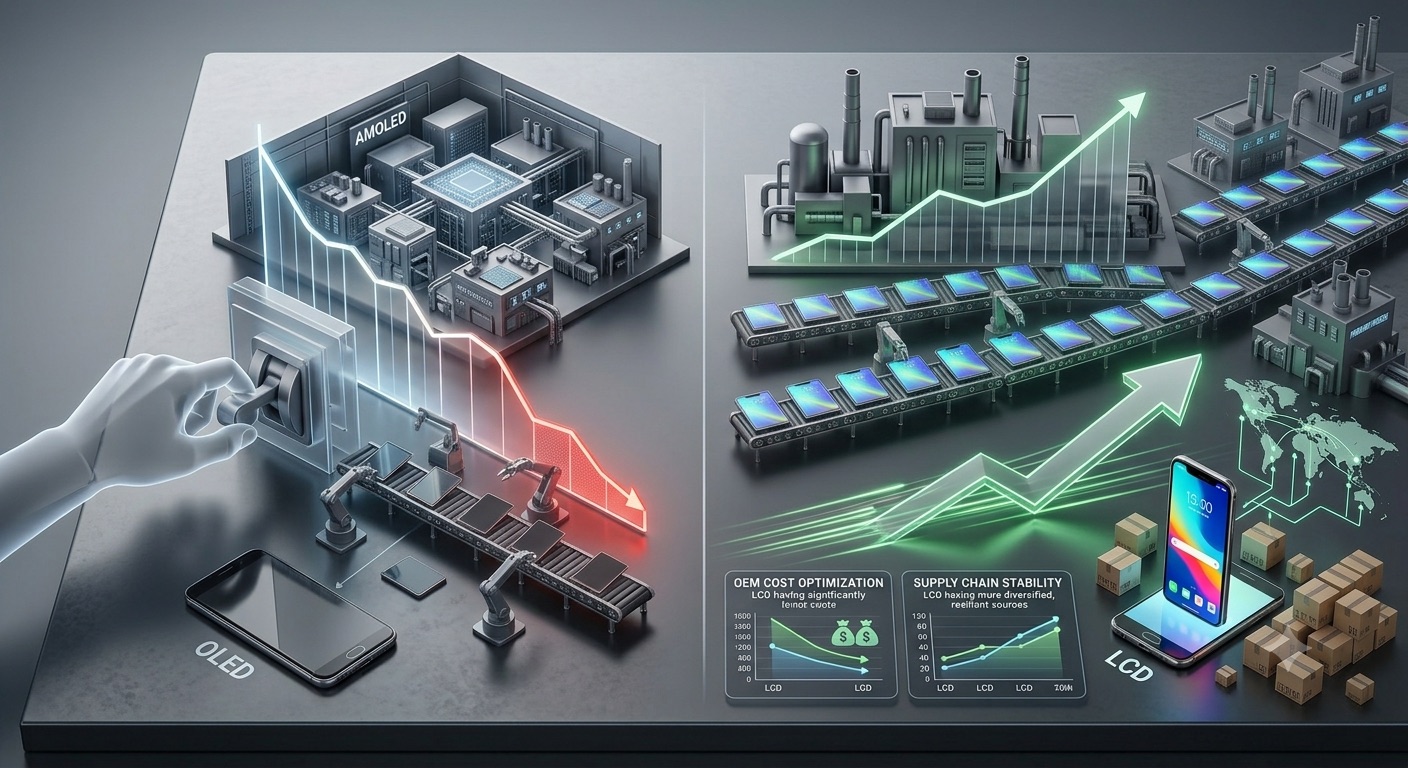
The 69% Signal: What the AMOLED Utilization Report Really Means for Your Supply Chain
For procurement directors and product managers tracking display costs, the latest industry data on AMOLED fab utilization is more than a headline—it is a strategic signal. Reports from display market analysts suggest that flexible AMOLED fab utilization has dipped to approximately 69% in recent quarters, a figure that reflects both overcapacity and softening demand in the premium smartphone segment. This number matters because it quantifies a shift in the balance of power between display technologies.
When utilization rates fall below the 75-80% breakeven threshold for most Gen-6 flexible OLED lines, panel manufacturers face pressure to either cut prices or reduce output. For OEMs, this creates a ripple effect. Lower utilization does not automatically mean cheaper panels; it often signals market volatility, shorter allocation windows, and a greater risk of supply disruptions as fabs idle lines. For buyers evaluating display supply chain risks, this is the moment to question whether sole-sourcing flagship AMOLED panels is a resilient strategy.
The 69% figure also highlights a structural reality: the global flexible OLED capacity expansion over the past three years outpaced actual demand growth. Chinese panel makers added significant Gen-6 capacity, but the smartphone market has not grown proportionally. The result is a market where AMOLED pricing is under pressure, but not uniformly—and not without trade-offs in consistency and lead time.
Why Smartphone Brands Are Rebalancing: Demand Elasticity and Cost Sensitivity
Smartphone OEMs operate in a market defined by razor-thin margins, especially in the mid-range segment that accounts for the majority of global volumes. When AMOLED fab utilization drops, the instinct is to assume that AMOLED becomes cheaper and therefore more accessible. However, the reality is more nuanced.
The Mid-Range Squeeze
For devices priced between $200 and $500, display cost remains one of the top three BOM line items. In this segment, demand elasticity is high: a $5 increase in display cost can erase margin or force a price increase that reduces sell-through. As AMOLED panel prices fluctuate with utilization rates, OEMs face uncertainty in cost forecasting. LCD, by contrast, offers a mature, stable pricing curve. The technology has been in mass production for over two decades, and its cost structure is well-understood across the supply chain.
Shift in Order Patterns
Recent procurement patterns suggest that some smartphone brands are reallocating display orders away from flexible OLED back to high-end LTPS LCD for specific models. This is not a retreat from premium technology; it is a calculated response to cost sensitivity. When a brand can achieve 90% of the visual performance at 70% of the panel cost, the business case for LCD strengthens—especially in markets where consumers prioritize battery life and durability over peak brightness and infinite contrast ratios.
For B2B buyers, this means that the window for negotiating favorable LCD supply agreements is open now. Panel makers are eager to fill capacity, and long-term contracts for LCD modules are becoming more flexible.
LCD vs. AMOLED: Total Cost of Ownership and Supply Chain Reliability for OEMs
When evaluating display technology for a new smartphone model, the comparison should extend beyond pixel count and color gamut. For OEMs, total cost of ownership (TCO) includes panel cost, driver IC availability, backlight unit sourcing, module assembly yield, and end-of-life support.
Cost Structure Comparison
AMOLED panels carry higher material costs, particularly for the flexible substrate, encapsulation layer, and precision deposition equipment. Additionally, the yield rates for high-resolution flexible OLEDs remain lower than for equivalent LCDs, especially for panels with under-display camera cutouts or irregular shapes. Lower yield means higher per-unit cost and more waste. LCD modules, particularly those using a-Si or IGZO backplanes, benefit from mature manufacturing processes with yields consistently above 90%.
Supply Chain Risks
- Driver IC availability: AMOLED requires specialized OLED drivers, which have experienced allocation constraints in recent years. LCD drivers are more commoditized and available from multiple foundries.
- Polarizer and backlight continuity: LCD supply chains are diversified across China, Taiwan, and Korea. Flexible OLED relies heavily on a smaller number of upstream material suppliers.
- Lead time stability: Industry reports suggest that lead times for custom AMOLED modules can extend 8-12 weeks, while LCD modules from established manufacturers like Relialink can be delivered in 4-6 weeks for standard configurations.
Longevity and Aftermarket Support
For OEMs targeting markets with longer replacement cycles, LCD offers a pragmatic advantage. AMOLED panels are susceptible to burn-in over extended use, particularly in always-on display applications. LCDs do not suffer from organic material degradation in the same way, making them a more reliable choice for devices expected to operate for three years or more.
Where LCD Still Wins: Key Application Segments Beyond Flagship Phones
While flagship smartphones have largely migrated to AMOLED, LCD remains the dominant technology across several high-volume segments that OEMs cannot ignore.
Mid-Range and Entry-Level Smartphones
This is the largest volume segment globally, particularly in Asia, Africa, and Latin America. Here, LCD offers the best balance of cost, performance, and availability. A well-engineered LTPS LCD with a 90Hz refresh rate and 500-nit brightness provides a user experience that satisfies the vast majority of consumers.
Industrial and Ruggedized Handsets
For smartphones used in logistics, field service, and manufacturing environments, LCD is preferred for its durability, wider operating temperature range, and resistance to image retention. These devices are often specified with sunlight-readable LCDs that exceed 800 nits of brightness.
Dual-Display and Foldable Concepts
Some innovative form factors use a combination of AMOLED for the primary foldable display and LCD for the secondary cover display. This hybrid approach optimizes cost while maintaining a premium primary screen.
Automotive-Grade Displays
Although not the focus of this article, it is worth noting that the automotive sector continues to adopt LCD for instrument clusters and infotainment systems, where reliability and long-term availability are critical. This reinforces the broad ecosystem support for LCD technology.
For OEMs evaluating their next product roadmap, the data suggests that LCD will remain a strategic technology for at least the next 3-5 years, especially as panel makers invest in advanced a-Si and IGZO production lines.
How Relialink Helps Customers Navigate Display Technology Volatility
In a market where AMOLED fab utilization fluctuates and supply chain disruptions can halt production, having a reliable LCD module partner is a competitive advantage. Relialink has been manufacturing LCD modules for over a decade, serving industrial, medical, and consumer electronics OEMs with consistent quality and on-time delivery.
Our Approach
- Flexible sourcing: We maintain relationships with multiple panel suppliers, ensuring that our customers are never dependent on a single fab for critical components.
- Custom module design: From touch panel integration to custom backlight brightness levels, we tailor LCD modules to specific application requirements.
- Inventory buffers: For high-volume smartphone projects, we offer consignment inventory programs that reduce lead time risk.
- Technical support: Our engineering team assists with display interface selection, mechanical integration, and optical characterization to ensure your product meets specification.
A Practical Example
Consider a mid-range smartphone OEM targeting a launch in Q3 2026. By selecting a Relialink 6.5-inch FHD+ LCD module with a 60Hz refresh rate and 500-nit brightness, the customer can achieve a BOM savings of approximately 30% compared to a comparable flexible OLED panel, while securing a lead time of 6 weeks instead of 10. For a production run of 500,000 units, that translates into significant margin protection.
Looking for a reliable LCD module supplier for your next smartphone or industrial display project? Contact Relialink today to discuss your custom requirements and see how our LCD solutions can strengthen your supply chain.
Key Takeaways for Your Next Display Sourcing Decision
The decline in AMOLED fab utilization to 69% is not a signal to abandon LCD—it is a reminder that display technology decisions should be driven by total cost, supply chain stability, and application fit, not by trend alone. As smartphone brands rebalance their display portfolios, LCD remains a resilient, cost-effective, and readily available option for the segments that drive volume.
For B2B buyers and product managers, the current market conditions present a strategic window. Locking in LCD supply agreements now, while AMOLED capacity is underutilized and LCD pricing remains competitive, can protect your margins and ensure production continuity through the next product cycle.