COG LCD Modules (Chip-on-Glass)
Chip-on-Glass LCD technology integrates the driver IC directly onto the panel — eliminating the PCB and delivering the thinnest possible display module profile.
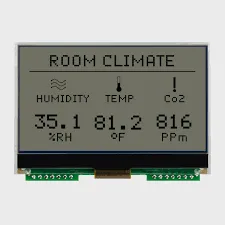
Product Overview
COG (Chip-on-Glass) is a display packaging technology where the driver integrated circuit is bonded directly onto the glass substrate of the LCD panel using ACF (Anisotropic Conductive Film) adhesive. By eliminating the separate driver PCB found in conventional LCD modules, COG displays achieve significantly thinner profiles, lighter weight, and smaller footprints — making them the preferred choice for compact, portable, and wearable product designs.
Relialink's COG LCD modules are available in graphic and numeric segment configurations, with SPI and I2C interfaces for straightforward connection to any microcontroller. Common sizes range from 1.8" to 3.2" diagonal, with standard resolutions including 96x64, 128x64, and 132x64. Both positive (dark pixels on light background) and negative (light pixels on dark background) display modes are available depending on backlight color selection.
The thin cross-section and minimal component count make COG modules attractive not only for wearables and portable instruments but also for any product design where PCB space is at a premium and display depth must be minimized.
Key Features
Ultra-Thin Profile
Typically less than 3mm total module thickness — significantly thinner than conventional LCD modules with separate driver PCB.
Lightweight Design
Eliminating the separate PCB reduces component count and overall weight — critical for wearable and portable products.
SPI and I2C Interfaces
Simple 3-4 wire interfaces minimize MCU pin usage and simplify PCB routing.
Positive and Negative Modes
Both positive (dark on light) and negative (light on dark) display modes available depending on backlight selection.
Low Component Count
Minimal external components required — driver IC is bonded directly to the glass, reducing BOM complexity.
Optional LED Backlight
Available in various colors — white, blue, yellow-green, and amber for different aesthetic requirements.
Specifications
| Technology | Chip-on-Glass (COG) |
| Size Range | 1.8" to 3.2" typical |
| Resolution | 96x64, 128x64, 132x64, 128x128 |
| Interface | SPI (3/4-wire), I2C |
| Controller IC | ST7567, UC1701, ST7565, NT7538 |
| Display Mode | Positive / Negative |
| Backlight | Optional LED (various colors) |
| Module Thickness | Typically < 3mm |
| Operating Temperature | -20°C to +70°C (standard) |
| Supply Voltage | 3.3V |
| Compliance | RoHS |
Applications
Wearable Devices
Smartwatch accessories, fitness bands, and health monitoring wearables benefit from COG's ultra-thin profile and light weight.
Handheld Instruments
Portable test equipment, handheld multimeters, and field instruments use COG modules for compact, rugged display integration.
Smart Meters
Electricity, water, and gas meters use COG displays for reliable numeric readout with minimal power consumption.
Medical Wearables
Portable patient monitors, insulin pumps, and health tracking devices use COG displays for compact, low-power operation.
Remote Controls
Universal remote controls and smart home controllers use COG modules for clear status display in a slim form factor.
Portable Audio Equipment
Digital audio players, headphone amplifiers, and recording equipment use COG displays for compact GUI integration.
Related Products
Request a COG LCD Sample
Contact our sales team to discuss your COG LCD requirements. Standard and custom configurations available.
Related Reading
COG LCD Modules: When Chip-on-Glass Beats a Standard Module
Why the driver sits on the glass, how much thickness COG really saves, FPC design rules, and when a framed module is cheaper.
Read moreHow AI-Powered Manufacturing Elevates LCD Module Quality and Supply Chain Efficiency
Discover how AI-powered manufacturing transforms LCD module quality and supply chain efficiency. Learn how smart factories reduce defects and optimize delivery for industrial OEMs.
Read moreHow US-China Trade Restrictions on Display Equipment Are Reshaping LCD Module Supply Chains
Discover how US-China display equipment export controls are reshaping LCD module supply chains and why industrial buyers are turning to stable, vertically
Read moreOLED vs LCD: Choosing the Right Display Module for Industrial and Embedded Applications
Learn the key differences between OLED and LCD for industrial, medical, and automotive applications. Discover why LCD modules offer superior reliability, lifespan, and total cost of ownership for embedded systems.
Read moreHow to Choose a 12.1-Inch Sunlight Readable LCD Module for Industrial Applications
Learn how to choose a 12.1-inch sunlight readable LCD module for industrial HMIs. Compare brightness, backlight options, and ruggedization for reliable outdoor performance.
Read more