Foldable Displays: OLED vs. LCD and What It Means for the Display Module Industry
The Foldable Revolution and Its Display Demands
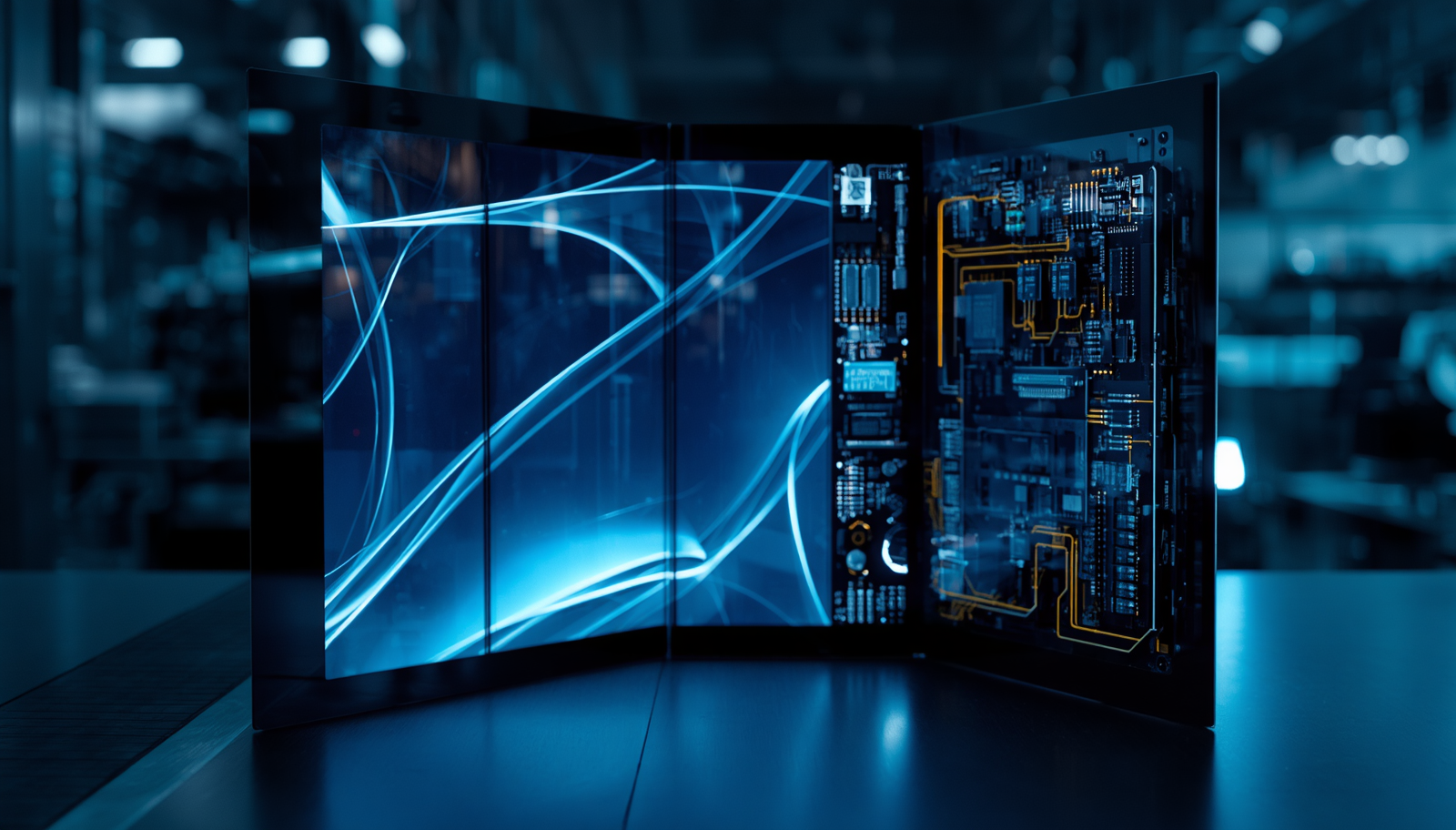
The recent confirmation of a foldable iPhone using OLED has sent ripples through the display supply chain. For hardware engineers and procurement professionals, this isn’t just a consumer gadget update—it signals a major inflection point in display industry trends. The foldable form factor demands a display that can bend repeatedly without failure, maintain image quality under mechanical stress, and fit into radically thinner device architectures. This has forced the entire display module industry to re-evaluate material science choices, assembly processes, and reliability testing protocols.
While the consumer electronics world races toward foldable designs, it is critical for B2B decision-makers in industrial, medical, and automotive sectors to understand why this technology path is not automatically transferable to their applications. The choice between foldable display technologies is not merely about flexibility—it is a deep trade-off between performance, cost, and long-term reliability that directly impacts your product’s lifecycle and total cost of ownership.
Why OLED Dominates Foldable Designs
Unmatched Flexibility and Thinness
OLED’s inherent advantage in foldable applications starts with its fundamental structure. Unlike LCD, which requires a backlight unit, polarizers, and multiple glass substrates, OLED is an emissive technology where each pixel generates its own light. This allows the entire display stack to be dramatically thinner—often under 0.5mm for the panel itself. For a foldable device, every micron of thickness reduction translates directly into a smaller bend radius and less mechanical strain on the hinge mechanism.
The active layer in OLED can be deposited on flexible polyimide substrates rather than rigid glass. This material substitution is the single most important enabler of foldable displays. Polyimide can withstand bending radii of 1-3mm for hundreds of thousands of cycles when properly engineered, something a traditional LCD stack cannot achieve without catastrophic failure.
Superior Optical Performance in Thin Form Factors
OLED delivers contrast ratios that LCD cannot match in a thin package. With true blacks achieved by simply turning off pixels, OLED offers virtually infinite contrast. This is particularly valuable in foldable devices where ambient light management becomes more complex due to the multi-surface design. The fast response time of OLED—typically microseconds versus milliseconds for LCD—also eliminates motion blur that would be more noticeable on a foldable screen used in tablet mode.
The Cost and Reliability Trade-Off
However, these advantages come at a price. OLED panels for foldable applications remain significantly more expensive to manufacture than equivalent-size LCDs. Industry reports suggest foldable OLED panels cost 3-5 times more than comparable rigid OLED or LCD panels. More critically for B2B applications, OLED suffers from organic material degradation over time. Blue OLED materials have shorter lifespans, leading to color shift and burn-in issues in always-on applications like industrial control panels or medical monitors.
Why LCD Holds Firm in Industrial, Medical, and Automotive Applications
Reliability Under Extreme Conditions
For hardware engineers designing equipment that must operate reliably for 5-10 years in harsh environments, LCD remains the undisputed choice. LCD modules can maintain consistent brightness and color accuracy across operating temperature ranges from -20°C to +70°C or wider, with some industrial-grade variants rated for -30°C to +85°C. OLED, particularly flexible variants, shows significant performance degradation at temperature extremes, with accelerated aging above 60°C and reduced brightness below 0°C.
The organic layers in OLED are inherently sensitive to moisture and oxygen. Even with advanced encapsulation techniques, flexible OLEDs have higher permeability rates than rigid glass-based LCDs. In medical environments requiring sterilization cycles or industrial settings with high humidity, LCD’s sealed glass construction provides a proven reliability advantage.
Cost-Effectiveness for Non-Foldable Applications
The display industry trends show a clear bifurcation: consumer foldable devices justify premium OLED costs, but the vast majority of B2B applications do not require flexibility. A standard LCD module manufacturer can deliver high-brightness (1000+ nits) displays with wide viewing angles at a fraction of the cost of any flexible OLED solution. For a 10-inch industrial display, the cost difference can be 60-70% in favor of LCD, with equivalent or superior performance in key metrics like readability under sunlight.
- Brightness: LCD can achieve 1500-2000 nits with proper backlight design; flexible OLED typically maxes out around 600-800 nits
- Lifetime: LCD backlights rated for 50,000-100,000 hours; OLED blue subpixels degrade noticeably after 30,000-40,000 hours
- Temperature range: LCD covers -30°C to +85°C; flexible OLED is limited to -20°C to +60°C for reliable operation
- Cost per diagonal inch: $0.50-$1.50 for industrial LCD vs $5-$15 for foldable OLED
The Optical Performance That Matters
For medical imaging or automotive instrument clusters, color accuracy and uniformity across the entire display area are critical. LCD technology has matured to deliver 100% sRGB coverage with Delta E < 2 in premium modules. OLED, while offering excellent contrast, often struggles with color uniformity across large panels due to manufacturing variations in organic material deposition. This is particularly problematic in medical applications where consistent grayscale reproduction is essential for diagnosis.
Manufacturing Complexity: Foldable OLED vs. Standard LCD Assembly
The Assembly Challenge of Flexible Displays
Foldable OLED module assembly represents a quantum leap in manufacturing complexity compared to standard LCD module production. The difference begins at the substrate level. While LCD modules are assembled using well-established processes with glass substrates that maintain dimensional stability, flexible OLEDs require handling of thin polyimide films that can stretch, wrinkle, or misalign during processing.
The encapsulation layer for flexible OLED is another critical differentiator. Standard LCD modules use a simple glass-to-glass seal with a perimeter adhesive. Foldable OLEDs require thin-film encapsulation (TFE) using alternating layers of inorganic and organic materials deposited at precise thicknesses. This process adds significant cost and yield challenges. Industry data suggests foldable OLED production yields are 60-75% compared to 90-95% for mature LCD production.
Integration Complexity for OEMs
For a display module manufacturer, the integration requirements differ fundamentally. LCD modules can be delivered as complete units with standard mechanical frames, bezels, and mounting points. Foldable OLED modules require custom hinge mechanisms, dynamic bending management, and specialized cover glass that must flex with the display. This dramatically increases the engineering effort required for integration.
For hardware engineers evaluating display options, this means foldable OLED projects require significantly longer development cycles and higher NRE (non-recurring engineering) costs. A standard LCD module can be specified and integrated in 8-12 weeks; a custom foldable display solution typically requires 6-12 months of co-development.
Relialink’s Position in the Evolving Display Landscape
While the display industry trends emphasize foldable and flexible technologies, Relialink has strategically focused on what matters most to our B2B customers: reliability, longevity, and cost-effectiveness in mission-critical environments. As a professional LCD module manufacturer, we have deep expertise in engineering displays that operate flawlessly in industrial automation, medical diagnostic equipment, automotive infotainment, and transportation systems.
Our manufacturing capabilities cover the full range of LCD technologies—from standard TN and STN to advanced TFT with IPS and VA modes. We deliver modules with custom brightness levels, optical bonding for outdoor readability, extended temperature ranges, and specialized interface protocols including LVDS, eDP, and MIPI. Each module undergoes rigorous testing to ensure it meets the specific environmental and reliability requirements of your application.
The shift toward OLED in consumer devices does not diminish LCD’s relevance; it reinforces the importance of choosing the right technology for the right application. For applications where flexibility is not required, LCD continues to offer the optimal balance of performance, cost, and proven reliability. Our engineering team works closely with customers to optimize display specifications for their unique operating conditions, ensuring that every module delivers consistent performance over its intended lifecycle.
Looking for a reliable LCD module supplier for your next industrial, medical, or automotive project? Contact Relialink today to discuss your custom display requirements and discover how our robust LCD solutions can meet your mission-critical needs.