Fraunhofer OLED Microdisplay: Complete Overview
Background: Understanding the Fraunhofer OLED Microdisplay
If you work in display procurement for industrial, medical, or automotive products, you have likely encountered the name Fraunhofer in a supplier deck or technology roadmap. The Fraunhofer OLED microdisplay program is one of the more frequently cited examples of European display research translating into commercial silicon. Understanding what it actually is — and what it is not — matters before you write it into a bill of materials.
Fraunhofer is not a single company. It is a network of applied research institutes across Germany, and display-related work is distributed across several of them. The best-known microdisplay activities have historically centered on CMOS-backed OLED-on-silicon architectures, developed in partnership with industrial partners and later commercialized through spin-outs and licensing arrangements. In practical terms, a “Fraunhofer microdisplay” usually refers to a technology platform rather than a catalog part number you can order in volume tomorrow.
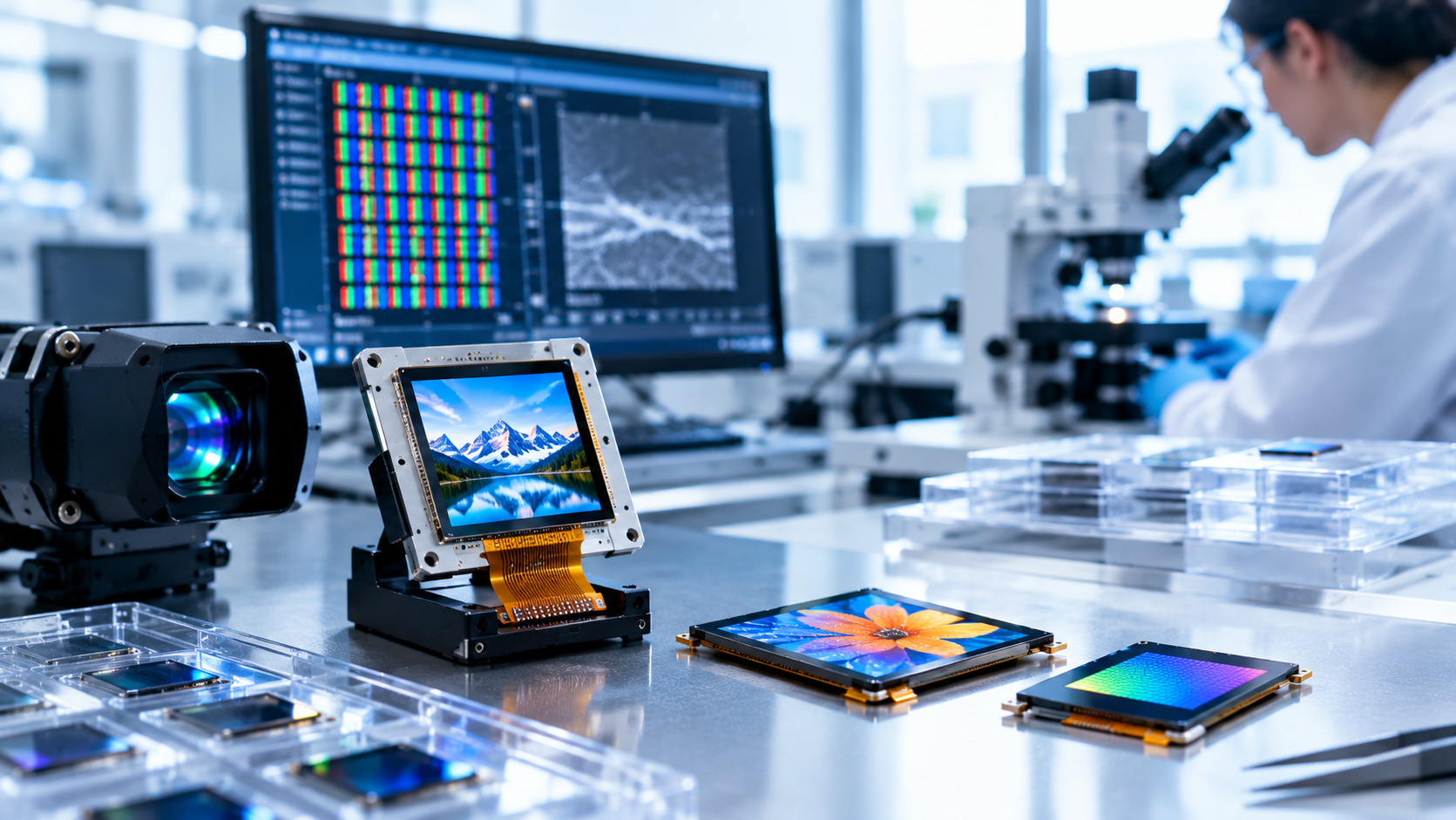
The core idea is straightforward: instead of driving a glass TFT backplane, an OLED emitter stack is deposited directly onto a silicon CMOS wafer. Because the drive circuitry sits beneath each pixel, you get very small pixel pitches and very high pixel densities in a package measured in fractions of an inch. That is the opposite design philosophy from the large-format LCD modules most industrial buyers source.
This distinction is the first thing procurement teams need to internalize. A Fraunhofer OLED microdisplay competes in a different application space than a 7-inch industrial TFT or a 10.1-inch medical panel. It is aimed at near-to-eye systems, viewfinders, head-mounted displays, surgical visualization, and high-end instrumentation where the display is viewed through optics at close range.
Current Industry Context and Key Data Points
The microdisplay segment has drawn renewed attention as AR, VR, and wearable medical devices have matured. Industry reports suggest that near-to-eye applications represent one of the faster-growing niches in the display market, though volumes remain small compared with mainstream flat-panel categories. Analysts estimate that the total microdisplay market — spanning OLED-on-silicon, LCoS, and micro-LED approaches — is still measured in the low millions of units annually, which shapes how you should think about supply risk.
Several structural factors define the current landscape:
- Silicon-limited capacity. OLED microdisplays are fabricated on CMOS wafers, so capacity is tied to foundry allocation rather than traditional panel fabs. This creates different lead-time dynamics than LCD.
- Competitive fragmentation. European research platforms, Japanese display makers, and Chinese manufacturers are all pursuing OLED-on-silicon, with varying degrees of commercialization maturity.
- Micro-LED pressure. Micro-LED is frequently positioned as the long-term successor for high-brightness near-to-eye use cases, but manufacturing yield and cost remain significant barriers at small pixel pitches.
- Regulatory pull. Medical and defense applications value the high contrast and fast response of OLED microdisplays, but also impose qualification burdens that slow adoption.
It is worth being honest about trade-offs here. OLED microdisplays offer exceptional contrast, wide color gamut, and fast switching. They also carry known concerns around lifetime, burn-in under static content, and brightness degradation over operating hours. For a surgical headset used intermittently, that may be acceptable. For a continuously operating industrial HMI, it usually is not — which is precisely why LCD remains the default for most fixed-installation products.
Another frequently overlooked point is that “Fraunhofer” as a search term often surfaces alongside queries about Fraunhofer LCD research. Fraunhofer institutes have contributed broadly to liquid crystal materials, backlighting, and display metrology, not only to OLED. Buyers researching the ecosystem should separate the two threads: microdisplay work is a narrow, optics-driven niche, while LCD-related research informs mainstream panel and module performance.
Implications for B2B Display Procurement
For most procurement directors reading this, the practical question is not “should we adopt a Fraunhofer OLED microdisplay?” It is “does this technology change our sourcing strategy for the products we actually build?” The answer depends heavily on your application class.
When OLED microdisplays make sense
Consider OLED-on-silicon when your product meets several of these conditions:
- The display is viewed through magnifying optics at a short distance
- High contrast and deep blacks materially improve the user experience
- The unit is battery-powered and power efficiency per pixel matters
- Production volumes are modest and unit economics tolerate a premium
- Your customer accepts a defined operating-life specification
When LCD modules remain the better choice
Stay with proven LCD module platforms when:
- The display is panel-mounted and viewed at arm’s length or greater
- Continuous duty cycles of tens of thousands of hours are required
- Operating temperature extremes, sunlight readability, or ruggedization dominate
- You need multi-source supply and predictable lead times
- Cost per unit is a primary constraint
For the majority of industrial and medical OEMs, the second list describes reality. A reliable LCD module supplier relationship — with qualified second sources, documented change-control processes, and automotive or medical-grade options — delivers more value than chasing an emerging microdisplay platform.
Supply chain and qualification risk
Microdisplay sourcing introduces risks that LCD buyers rarely face. Because the emitter stack is deposited on silicon, a process change at the foundry can ripple into optical performance. Tooling and mask sets are application-specific, so switching suppliers mid-program is expensive. Qualification cycles for medical or automotive use can run well beyond a typical product development schedule.
There is also the question of long-term availability. Research-derived platforms sometimes transition between commercial entities, and continuity of supply is not guaranteed in the way it is for a mature LCD line with multiple fabs producing compatible parts. Procurement teams should build exit ramps into any microdisplay design — a socketed optical module, a documented alternative, or a clear end-of-life plan.
How Relialink Can Help Buyers Navigate This Topic
Relialink is an LCD module manufacturer, not a microdisplay house, and we are upfront about that boundary. Our value to buyers evaluating the OLED microdisplay landscape is not in supplying the silicon — it is in helping you make a sound architectural decision about where the display fits in your product.
In practice, that support takes several forms. We work with engineering teams to characterize the actual viewing conditions of a product: distance, ambient light, duty cycle, and thermal environment. Those inputs determine whether a microdisplay is justified or whether a high-brightness TFT module with the right optical bonding and backlight design will meet the requirement at a fraction of the cost and risk.
We also help procurement teams structure the commercial side. That includes defining realistic lifetime and brightness specifications, establishing incoming inspection criteria, and planning second-source strategies. When a customer is weighing a Fraunhofer microdisplay platform against a conventional module, we can provide comparative data on operating temperature range, interface options, and total cost of ownership so the decision is grounded in numbers rather than marketing.
Our manufacturing experience spans industrial, medical, and automotive-grade LCD modules, including wide-temperature and high-brightness variants. That background means we understand the qualification language your customers use — and we can translate it into module specifications that survive an audit.
If your team is exploring near-to-eye or high-density display options and wants an honest assessment of where LCD still wins, we are happy to be the second opinion.
Actionable Next Steps and Selection Criteria
Whether you ultimately choose an OLED microdisplay platform or a conventional LCD module, the evaluation process should follow a disciplined path. The following criteria apply across both technology families and will keep your program defensible.
1. Define the optical use case first. Specify viewing distance, magnification, field of view, and ambient illumination before selecting any display technology. These parameters eliminate most candidates immediately.
2. Set lifetime and duty-cycle requirements in writing. Express them in operating hours at a defined brightness, not in vague terms. This single step prevents most field failures.
3. Quantify the thermal envelope. OLED emitters degrade faster at elevated temperatures. LCD performance shifts at temperature extremes. Either way, you need measured data, not datasheet optimism.
4. Establish interface and integration constraints. Confirm the interface protocol, timing requirements, and mechanical envelope early. Microdisplays typically use high-speed serial interfaces, while industrial LCD modules more commonly offer RGB, LVDS, or MIPI options.
5. Model total cost of ownership. Include optics, driver electronics, calibration, qualification testing, and expected replacement rates — not just the display unit price.
6. Plan for supply continuity. Identify at least one qualified alternative or a documented redesign path. For microdisplays, confirm the commercial entity responsible for long-term supply.
7. Validate with a pilot build. Prototype under real thermal and optical conditions before committing to tooling. This is where assumptions about brightness and contrast are either confirmed or corrected.
Run these seven checks against your current project, and the technology decision usually makes itself. In many cases, the outcome is a well-specified LCD module with the right backlight, bonding, and temperature range — sourced from a supplier who can support it for the life of the product.
Looking for a reliable LCD module supplier for your next project, or a technical second opinion on microdisplay versus LCD architectures? Contact Relialink today to discuss your custom display requirements with our engineering team.