HKC Display Manufacturing OLED Material: Complete Overview
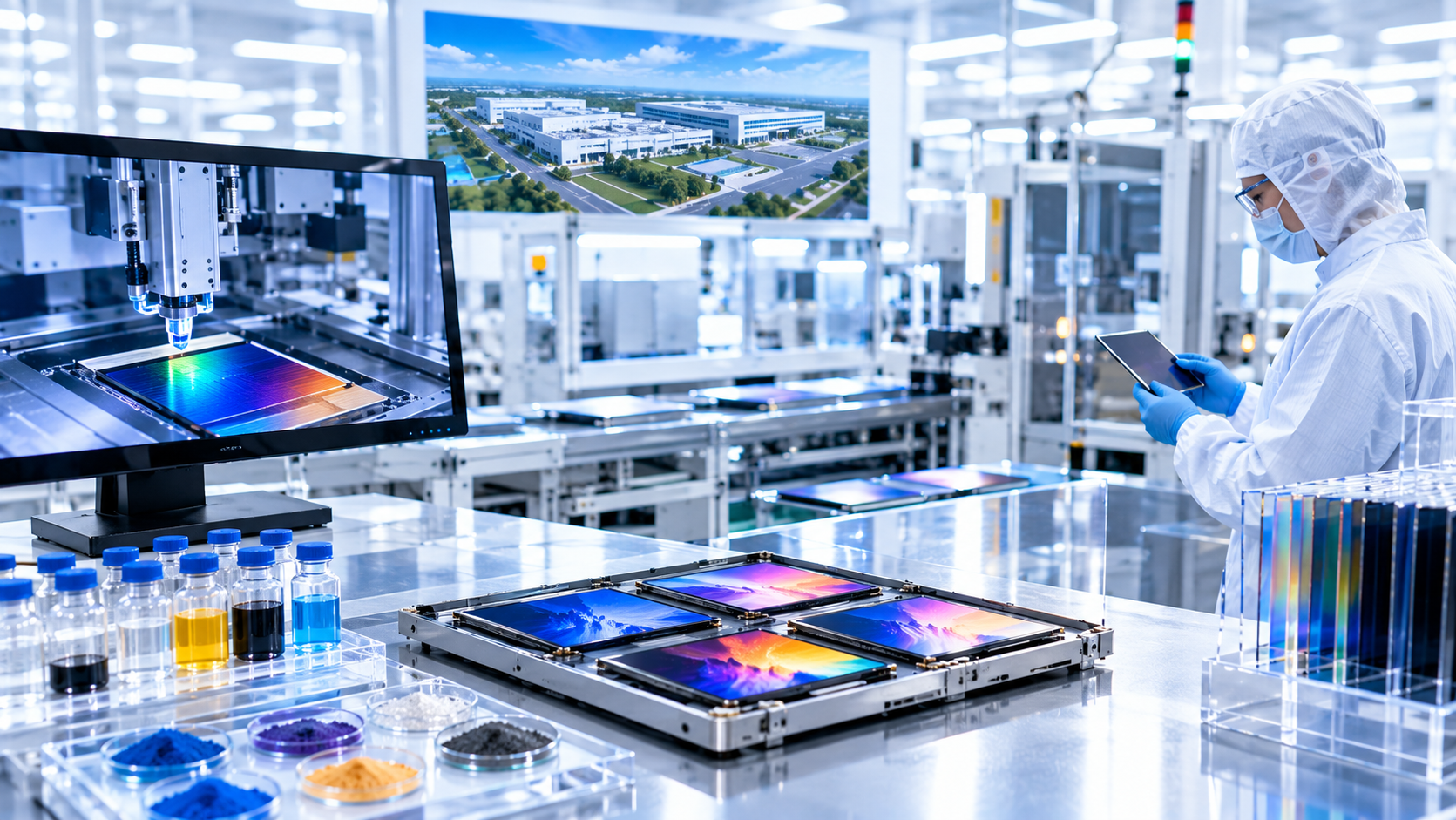
HKC Display has long been known as one of China’s most aggressive players in LCD panel production, particularly in the monitor and TV segment. Over the past several years, however, the company has been steadily extending its ambitions into OLED — including AMOLED — where material selection, deposition processes, and supply chain maturity determine whether a panel program succeeds commercially. For procurement directors and hardware engineers, understanding what HKC is doing with OLED materials is no longer a niche curiosity. It directly affects panel availability, pricing trajectories, and the competitive balance across the entire display supply chain.
The phrase “HKC display manufacturing OLED material” is really shorthand for a broader question: how is a historically LCD-focused manufacturer building competence in organic light-emitting materials, and what does that mean for buyers who currently source LCD modules or are evaluating OLED for future products?
To answer that, it helps to separate three layers:
- The material layer — organic host and dopant materials, emissive layers, and the evaporation sources used in fine metal mask (FMM) deposition.
- The process layer — how those materials are deposited, encapsulated, and yield-managed in a Gen 6 or larger fab.
- The commercial layer — how panel output from those lines reaches module makers, integrators, and OEMs.
HKC’s OLED activity sits primarily in the small-to-medium size AMOLED space, which is where the company’s investment in new fabs and material partnerships has been most visible. Industry reports suggest HKC has been qualifying multiple material suppliers rather than relying on a single source — a strategy that mirrors what established Korean and Chinese AMOLED leaders have done to manage risk and cost.
Current Industry Context and Key Data Points
AMOLED Capacity Is Shifting Eastward
For most of the past decade, AMOLED capacity was concentrated among a handful of Korean manufacturers. That picture has changed. Analysts estimate that Chinese panel makers now account for a meaningful and growing share of global AMOLED capacity, driven by aggressive fab construction and government-supported industrial policy. HKC is part of this wave, though its OLED ramp is more recent than that of some domestic peers.
This matters because material demand scales with capacity. As more Gen 6 AMOLED lines come online in China, the market for organic emissive materials, fine metal masks, and encapsulation materials expands — and so does the pressure on global material suppliers to localize production and pricing.
Material Localization Is the Central Story
The most consequential trend in HKC AMOLED material sourcing is localization. Chinese material suppliers have been steadily qualifying their red, green, and blue emitters, hosts, and common layers with domestic panel makers. Industry reports suggest that localization rates for some material layers have climbed significantly, though the most demanding layers — particularly blue emitters with long lifetime requirements — remain challenging.
For buyers, localization has two implications:
- Cost pressure downward — domestic material supply typically reduces panel cost over time.
- Performance variance risk — newer material combinations may show different lifetime or color-shift behavior than established recipes, which matters for long-life industrial and automotive applications.
The Blue Emitter Problem Persists
No discussion of OLED materials is complete without acknowledging blue. Blue OLED emitters degrade faster than red or green, which limits lifetime and drives up compensation complexity. Phosphorescent blue and thermally activated delayed fluorescence (TADF) approaches are active research areas, but commercial maturity varies. For HKC and its peers, blue material performance is often the gating factor for entering higher-end applications.
LCD Is Not Going Away
It is worth stating plainly: HKC’s LCD business remains enormous, and LCD technology continues to dominate industrial, medical, and many automotive display applications on a cost-per-unit-area basis. The OLED push is additive, not a replacement. Buyers should not assume that OLED material progress signals an imminent end to LCD module supply — quite the opposite.
Implications for B2B Display Procurement
Panel Availability and Lead Times
When a panel maker ramps a new AMOLED line, initial output often goes to anchor customers — typically smartphone or wearable brands with large committed volumes. Industrial and medical buyers may find themselves lower in the allocation queue during ramp periods. If your product roadmap includes AMOLED, plan for longer qualification cycles and consider dual-sourcing strategies early.
Pricing Trajectory
AMOLED pricing has historically followed a downward curve as yields improve and material costs decline. Localization of HKC AMOLED materials should reinforce that trend, but the curve is not smooth. Buyers should expect step changes tied to yield milestones rather than steady quarterly declines.
Specification Risk
Material changes — even within the same panel model — can shift color coordinates, lifetime, and brightness uniformity. This is a real procurement risk for:
- Medical imaging displays, where color accuracy and consistency are regulated.
- Automotive clusters and infotainment, where operating temperature range and lifetime are safety-relevant.
- Industrial HMI, where ten-year availability commitments are common.
The practical response is to lock specifications contractually and require change notification clauses from your panel or module supplier.
The LCD vs OLED Decision Framework
| Factor | LCD | AMOLED |
|---|---|---|
| Cost per unit area | Lower | Higher |
| Contrast (true black) | Limited by backlight | Excellent |
| Lifetime at high brightness | Very long | Improving, blue-limited |
| Operating temperature range | Wide, mature | Narrower, improving |
| Supply maturity for industrial | High | Developing |
| Flexibility/curvature | Limited | Native |
For most industrial and medical programs today, LCD remains the lower-risk choice. AMOLED becomes compelling when thin form factor, true black, or curved geometry are hard requirements.
How Relialink Can Help Buyers Navigate This Topic
Relialink operates at the module layer — the stage where panel glass becomes a usable display with backlight, driver ICs, interfaces, and mechanical integration. That position gives us visibility into both panel supply dynamics and the practical realities of integrating emerging display technologies into industrial products.
For buyers tracking HKC display manufacturing and OLED material developments, we can help in several concrete ways:
- Technology roadmapping support — We help product teams evaluate whether LCD, AMOLED, or another technology best fits a given application, based on lifetime, temperature, and cost constraints rather than marketing claims.
- Panel sourcing and qualification — We work with a range of panel sources and can advise on availability, second-source options, and specification stability.
- Module-level customization — Optical bonding, touch integration, interface conversion (LVDS, eDP, MIPI), and ruggedization are all handled at our level, which means you are not locked into a single panel vendor’s ecosystem.
- Change management discipline — We build change notification and requalification requirements into supply agreements, so material or process shifts at the panel level do not silently reach your production line.
We are honest about trade-offs. AMOLED is not automatically better than LCD, and a newer material set is not automatically better than a mature one. The right answer depends on your application, volume, and lifecycle expectations.
If your team is weighing OLED material trends against your next display program, this is exactly the kind of conversation we have daily. Contact Relialink to discuss your specific requirements — we will give you a straight assessment, not a sales pitch.
Actionable Next Steps and Selection Criteria
1. Define Your Non-Negotiables First
Before engaging any panel or module supplier, document the requirements that cannot be compromised:
- Operating temperature range (storage and operational)
- Required lifetime at target brightness
- Color accuracy and uniformity tolerances
- Interface and mechanical constraints
- Regulatory or certification requirements (IEC 60601 for medical, AEC-Q100-adjacent for automotive)
2. Ask Suppliers the Right Questions
When evaluating a supplier that references HKC AMOLED or similar emerging capacity, probe for specifics:
- Which material generation is currently in production, and what is the qualification status of next-generation materials?
- What is the change notification policy for material substitutions?
- What is the demonstrated lifetime data at your target brightness and temperature?
- What is the second-source strategy if primary panel allocation tightens?
3. Plan for a Two-Technology Strategy
For most industrial OEMs, the pragmatic approach is to maintain an LCD baseline while qualifying an AMOLED option for premium or next-generation products. This hedges against allocation risk and gives your design team real data rather than projections.
4. Build Requalification Into Your Process
Any time a panel maker changes OLED materials or deposition parameters, downstream optical and lifetime behavior can shift. Build a lightweight requalification protocol — color check, lifetime sample, temperature cycling — into your incoming inspection or periodic audit process.
5. Watch the Localization Curve, Not the Headlines
The most useful signal for procurement planning is not a single announcement but the steady localization rate of HKC OLED material supply. As domestic material qualification deepens, expect cost improvements and, eventually, more stable supply. Track it quarterly rather than reacting to individual news items.
Looking for a reliable LCD module supplier who understands both LCD and emerging OLED supply dynamics? Contact Relialink today to discuss your custom display requirements and build a sourcing strategy that holds up over your product’s full lifecycle.