How to Choose a 12.1-Inch Sunlight Readable LCD Module for Industrial Applications
Why Sunlight Readability Is Non-Negotiable for Outdoor and Industrial HMIs
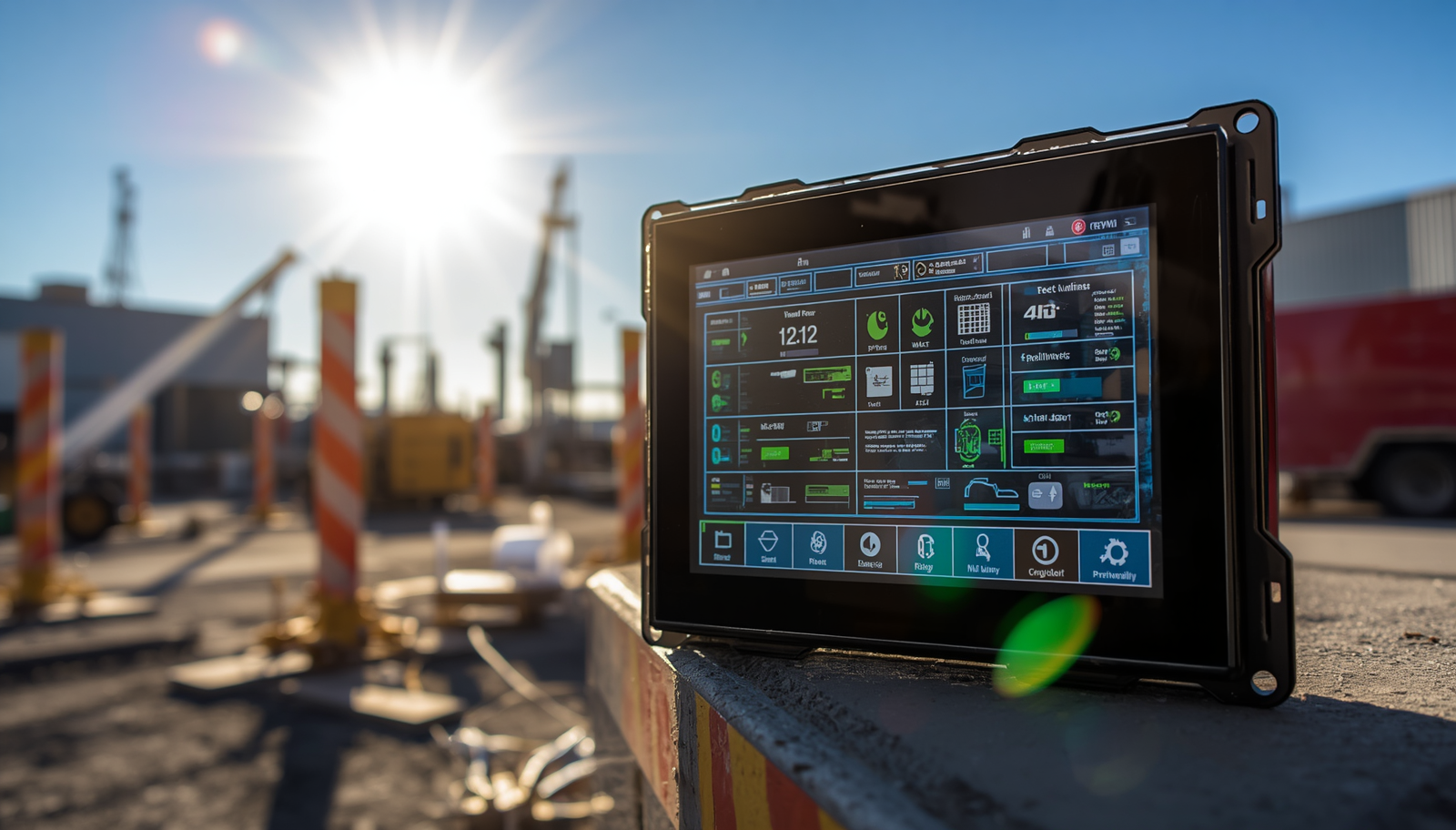
When your human-machine interface (HMI) sits on a construction vehicle, a medical cart, or a factory floor with windows, ordinary LCD panels become nearly invisible under direct sunlight. The operator squints, productivity drops, and critical readings get missed. For industrial applications that demand uptime and safety, sunlight readability is not a luxury—it is a core requirement.
A 12.1 inch sunlight readable display must deliver sufficient luminance to overcome ambient glare, maintain contrast under harsh lighting, and operate reliably across wide temperature ranges. Without careful selection, engineers risk deploying systems that fail in the field, leading to costly field returns and frustrated end users. This article walks you through the key technical decisions—from brightness specs to backlight architecture and bonding methods—so you can confidently specify the right industrial LCD module for your next project.
Key Optical Parameters: Brightness, Contrast Ratio, and Anti-Glare Treatments
Brightness: More Than Just High Nits
The most visible spec for a sunlight readable display is brightness, measured in nits (candelas per square meter). A typical indoor LCD operates at 250–500 nits. For outdoor or high-ambient-light environments, you need at least 800–1000 nits, and often 1200–1500 nits for direct sunlight exposure.
However, raw brightness alone can be misleading. A 1500-nit panel with poor contrast will still wash out in sunlight. The real metric is the contrast ratio under ambient illumination. Industry reports suggest that a contrast ratio of 800:1 or higher, measured in a lighted environment, provides acceptable readability. For critical applications like medical diagnostic carts or outdoor kiosks, aim for 1000:1 or better.
Contrast Ratio: The Hidden Hero
Contrast ratio determines how well bright and dark areas are distinguished. In direct sunlight, even a high-brightness LCD can appear milky if the black level rises. Optical bonding (discussed later) dramatically improves perceived contrast by reducing internal reflections. Without bonding, the air gap between the LCD cell and cover glass scatters light, lowering the effective contrast ratio by 30–50 percent.
Anti-Glare and Anti-Reflective Treatments
Surface treatments are another critical layer. An anti-glare (AG) coating diffuses reflected light, reducing specular reflections. Typical AG values range from 1% to 25% haze—higher haze reduces glare but can soften image sharpness. For touch-enabled HMIs, a 10–15% haze AG coating offers a good balance.
Anti-reflective (AR) coatings, on the other hand, reduce the amount of light reflected from the surface. AR coatings can cut reflections from 4–5% (untreated glass) to under 1%. However, AR coatings are more expensive and more fragile than AG. Many rugged display manufacturers combine AG and AR treatments in a single stack for optimal performance.
Backlight Technology Comparison: LED vs. CCFL and High-Brightness LED Driving Challenges
LED Backlights: The Modern Standard
Today, almost all 12.1 inch sunlight readable displays use LED backlights. LEDs offer higher efficiency, longer lifetime (50,000–100,000 hours), and a wider operating temperature range compared to older CCFL (cold cathode fluorescent lamp) technology. CCFL backlights are largely obsolete for new designs due to their mercury content, slower warm-up time, and lower luminance ceiling.
High-Brightness LED Driving: Thermal and Electrical Constraints
Pushing an LCD to 1000+ nits requires driving the LED array at higher currents. This generates significant heat. Without proper thermal management, LED junction temperatures rise, reducing light output and shortening lifespan. Manufacturers must design the backlight with:
- Higher-grade LED chips rated for extended current
- Aluminum or copper heat spreaders to dissipate heat
- Thermal interface materials between the LED strip and chassis
Additionally, the LED driver must be capable of delivering stable current under varying input voltages—common in automotive or battery-powered industrial equipment. A poorly designed driver can introduce flicker, audible noise, or premature failure.
Edge-Lit vs. Direct-Lit Backlights
For a 12.1-inch form factor, edge-lit backlights are common because they allow thinner modules. However, direct-lit (full-array) backlights can achieve higher peak brightness and more uniform luminance. For applications requiring 1500 nits or above, direct-lit is often the preferred choice. The trade-off is thickness and cost.
Custom Bonding and Ruggedization: Optical Bonding, Touch Integration, and IP Rating
Optical Bonding: Why It Matters
Optical bonding fills the air gap between the LCD cell and the cover glass or touch sensor with a transparent adhesive—either liquid optically clear adhesive (LOCA) or optically clear film (OCF). This single step improves the display in multiple ways:
- Reduces reflections by eliminating the second air-glass interface
- Increases contrast ratio in bright environments
- Prevents condensation and dust ingress
- Improves mechanical strength by laminating layers together
For a 12.1 inch sunlight readable display, optical bonding is strongly recommended. Without it, even a 1500-nit panel can look washed out under direct sun.
Touch Integration: Resistive vs. Projected Capacitive
Industrial HMIs often require touch input. For outdoor or gloved-hand use, resistive touch remains a reliable choice. It is lower cost, works with any stylus or gloved finger, and is less susceptible to water droplets. However, projected capacitive (PCAP) touch is becoming more common for its multi-touch support and optical clarity. When pairing PCAP with a high-brightness display, ensure the touch sensor stack does not introduce additional glare or reduce transmissivity.
IP Rating and Environmental Sealing
Sunlight readable displays for outdoor industrial applications must resist moisture, dust, and temperature extremes. A fully ruggedized module should meet at least IP65 on the front face. This requires gaskets between the display bezel and enclosure, and a sealed bonding process. For the display module itself, Relialink ensures that all edge seals and connectors are rated for condensation and thermal cycling.
How Relialink Optimizes 12.1-Inch LCD Modules for Total Cost and Supply Stability
Component Selection and Supply Chain
As a professional LCD module manufacturer, Relialink sources panels from tier-one LCD fabs and pairs them with custom backlight units. For high brightness LCD modules, we specify LEDs from leading manufacturers with proven thermal performance. By maintaining long-term relationships with multiple panel suppliers, we mitigate the risk of allocation or end-of-life issues—a common challenge in the industrial display market.
Design for Manufacturability
Our engineering team works closely with customers to optimize the module design for both performance and cost. For example, we may recommend a slightly different LED configuration that achieves the same brightness with fewer LEDs, reducing BOM cost without sacrificing reliability. We also offer multiple optical bonding options—from manual lamination for prototypes to automated bonding for volume production—so your unit cost scales predictably.
Testing and Validation
Every 12.1 inch sunlight readable display we ship undergoes rigorous testing: luminance uniformity, thermal cycling, vibration, and UV exposure. We provide detailed optical reports so your team can verify performance against your specifications. This upfront validation reduces the risk of field failures and costly redesigns.
Total Cost of Ownership
The cheapest module is rarely the most cost-effective. A low-cost 12.1-inch LCD with a generic backlight may fail after 10,000 hours in a hot enclosure, while a properly engineered high brightness LCD module from Relialink lasts 50,000 hours or more. When you factor in replacement labor, downtime, and warranty costs, the higher-quality module delivers a lower total cost of ownership. We help you evaluate these trade-offs during the specification phase.
Looking for a reliable 12.1 inch sunlight readable display for your next industrial HMI? Contact Relialink today to discuss your custom display requirements. Our engineers will help you select the right brightness, backlight, and bonding options for your application.
Related Reading
- Transflective LCD Technology: Balancing Sunlight Readability and Power Efficiency for Industrial Applications — the two main routes to sunlight readability: this article covers the high-brightness backlight + optical bonding approach; the transflective guide covers the reflective/transmissive hybrid approach for battery-critical designs.