InfoComm 2026: LED vs LCD Displays for Professional Digital Signage
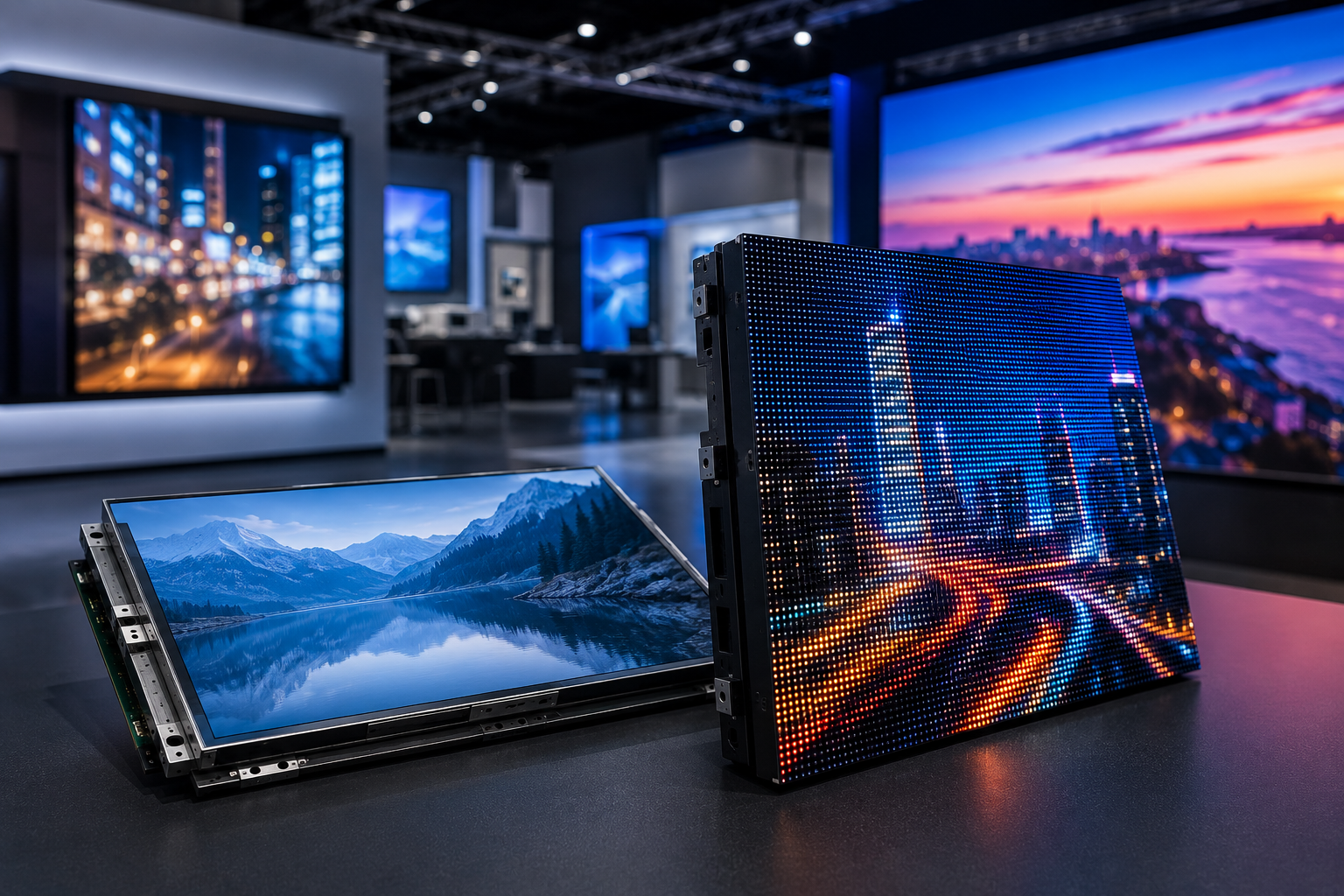
Why the LED vs LCD Display Debate Matters More Than Ever in 2026
If you walked the floor at InfoComm 2026, you saw it firsthand: LED display technology has made undeniable strides. Vendors like Watchfire unveiled new outdoor and indoor LED solutions that challenge long-held assumptions about where LED belongs. For B2B buyers—whether you’re a hardware engineer specifying a system, a product manager planning a rollout, or a procurement director managing budgets—the question is no longer if LED can compete with LCD, but when each technology makes the most sense for your specific digital signage application.
This article cuts through the marketing noise. We will examine the real-world differences between LED and LCD in brightness, power consumption, and environmental durability. We will also explore why high-resolution LCD modules remain the dominant choice for indoor close-view applications, and provide a total cost of ownership framework to help you decide. By the end, you will have a clear decision matrix for your next digital signage project.
InfoComm 2026 Highlights: Watchfire’s Latest Outdoor & Indoor LED Innovations
Watchfire’s presence at InfoComm 2026 was a clear signal that the LED display market is maturing rapidly. Their new outdoor LED panels boasted higher pixel densities and improved weather resistance, targeting applications that were once the exclusive domain of LCD. Specifically, Watchfire demonstrated fine-pitch LED cabinets designed for direct sunlight readability, with brightness levels exceeding 5,000 nits—a figure that standard industrial LCDs struggle to match without aggressive backlighting and thermal management.
For indoor environments, Watchfire introduced ultra-fine pitch displays (down to 0.9mm pixel pitch) that offer seamless tiling without visible bezels. This is a direct challenge to LCD video walls, which have always been limited by physical bezels between panels. The promise is compelling: a uniform, edge-to-edge image for high-end retail lobbies, control rooms, and corporate lobbies.
However, as any experienced display engineer will tell you, a trade show demo is not a production deployment. The real value lies in understanding how these LED innovations translate into day-to-day performance, maintenance, and cost over a 5- to 7-year lifecycle.
LED vs LCD in Digital Signage: Brightness, Power, and Environmental Hardiness
When comparing LED vs LCD digital signage, three technical parameters dominate the conversation: brightness, power consumption, and environmental tolerance.
Brightness and Sunlight Readability
For outdoor digital signage, brightness is non-negotiable. Direct sunlight can easily wash out a display rated below 1,500 nits. Here, LED has a clear advantage. Modern outdoor LED panels can achieve 5,000 to 8,000 nits, ensuring content remains legible even in harsh midday sun. LCD panels, by contrast, typically max out around 2,500 nits for industrial variants. While high-brightness LCDs exist, they require aggressive backlighting that generates heat and shortens component life.
Power Consumption and Thermal Management
The brightness advantage of LED comes at a cost. A typical outdoor LED display consumes 200-400 watts per square meter, depending on brightness settings and content. LCDs, especially modern IPS and VA panels with efficient LED backlights, often consume 100-250 watts per square meter for similar screen sizes. However, this comparison is nuanced. LED displays can be dimmed significantly in low-light conditions, reducing power draw, whereas LCD backlights maintain a more consistent load.
Thermal management is another critical factor. High-brightness LCDs require active cooling—fans or even liquid cooling—to prevent overheating in outdoor enclosures. LED panels, being self-emissive, dissipate heat more efficiently across the surface, but their power supplies and driver ICs still need careful thermal design.
Environmental Hardiness
For outdoor installations, both technologies must withstand temperature extremes, humidity, and dust. Industrial-grade LCD modules from manufacturers like Relialink are built with wide-temperature liquid crystals and robust bonding to prevent condensation. They are typically rated for -20°C to +70°C operation. LED panels, especially those designed for outdoor use, can often handle a wider range, from -30°C to +80°C. However, LED’s vulnerability to moisture ingress at the pixel level remains a concern, requiring high IP ratings (IP65 or higher) for outdoor deployments.
Indoor Applications: Why High-Resolution LCD Modules Still Dominate Close-View Use Cases
While LED is making inroads indoors, the reality is that high-resolution LCD modules remain the workhorse for the majority of professional indoor digital signage. The reason is simple: pixel density and viewing distance.
The Pixel Density Advantage
A typical 55-inch 4K LCD module has a pixel pitch of approximately 0.315mm. To match that resolution with an LED display, you would need a pixel pitch of 0.6mm or finer, which is still extremely expensive and often requires specialized installation. For close-view applications—think retail point-of-sale displays, interactive kiosks, or wayfinding screens viewed from 1-3 meters—LCD delivers a sharper, more detailed image at a fraction of the cost per pixel.
Color Accuracy and Uniformity
Industrial LCD modules, particularly those using IPS or VA technology, offer excellent color accuracy and wide viewing angles (178° horizontal and vertical). This is critical for applications like medical imaging, design studios, or premium retail where color consistency matters. LED displays, while improving, can still exhibit color shift across the panel and require periodic calibration to maintain uniformity.
Bezel Management for Video Walls
For video wall applications, LCD’s bezel is often cited as a drawback. However, modern ultra-narrow bezel LCD panels (down to 3.5mm) have largely mitigated this issue for most use cases. The bezel becomes invisible at typical viewing distances of 3-5 meters. Only in control rooms or high-end lobbies where a seamless image is paramount does LED’s bezel-free advantage become truly compelling.
Total Cost of Ownership: Maintenance, Lifespan, and Relialink’s Industrial LCD Reliability
For B2B procurement, the initial purchase price is only one piece of the puzzle. A total cost of ownership (TCO) analysis reveals deeper differences between LED and LCD.
Lifespan and Degradation
Industrial LCD modules are typically rated for 50,000 to 100,000 hours of operation, depending on the backlight technology. LED backlights degrade gradually, with the panel often remaining usable even after 70,000 hours. LED displays, on the other hand, are rated for 100,000 hours, but individual pixels can fail prematurely. A single dead pixel on an LED wall is more noticeable and requires module replacement, whereas a stuck pixel on an LCD is often less critical.
Maintenance and Serviceability
LCD modules are relatively simple to replace. If a panel fails, you swap it out in minutes. For LED cabinets, repair is more complex. A failed power supply or driver IC can take down an entire tile, and replacement modules must be color-matched to adjacent tiles, which can be challenging over time.
Relialink’s Industrial LCD Reliability
As an industrial LCD module supplier, Relialink designs displays specifically for harsh environments. Our modules feature reinforced mechanical frames, wide-temperature liquid crystals, and high-reliability LED backlights rated for 70,000+ hours. For outdoor applications, we offer optical bonding to eliminate condensation and reduce glare. For medical and industrial settings, we provide custom interfaces (LVDS, eDP, HDMI) and touch integration. This focus on reliability translates directly to lower maintenance costs and longer service life for your digital signage deployment.
Selecting the Right Display: A Decision Framework for Product Managers and Engineers
To simplify your decision, use the following criteria:
- Viewing Distance: If viewers are within 3 meters, choose high-resolution LCD. For distances beyond 5 meters, LED becomes viable.
- Brightness Requirements: For direct sunlight, LED is preferred. For shaded outdoor or indoor, LCD is more cost-effective.
- Total Cost of Ownership: Calculate over 5 years including installation, power, maintenance, and replacement. LCD often wins for smaller installations (under 50 square feet).
- Installation Environment: For extreme temperatures or high humidity, evaluate both technologies’ rated specifications carefully.
- Content Type: For static or slowly changing content, LCD’s burn-in risk is minimal. For dynamic video, both perform well.
Making Your Next Display Investment with Confidence
The LED vs LCD digital signage debate is not about which technology is “better.” It is about matching the right display to your application’s specific demands. InfoComm 2026 showed that LED is closing the gap, but for the majority of professional indoor and outdoor signage applications, high-resolution LCD modules from a trusted industrial LCD module supplier like Relialink remain the most reliable, cost-effective choice.
Looking for a reliable LCD module supplier for your next digital signage project? Contact Relialink today to discuss your custom display requirements and get a quote tailored to your application’s brightness, resolution, and environmental needs.
Related Reading
- Curved LED vs. LCD Video Walls: What Engineers Need to Know for Large Venue Displays — how curvature and venue-scale requirements shift the LED vs LCD calculation.