Curved LED vs. LCD Video Walls: What Engineers Need to Know for Large Venue Displays
Why the Colorado Convention Center Installation Matters for Your Next Project
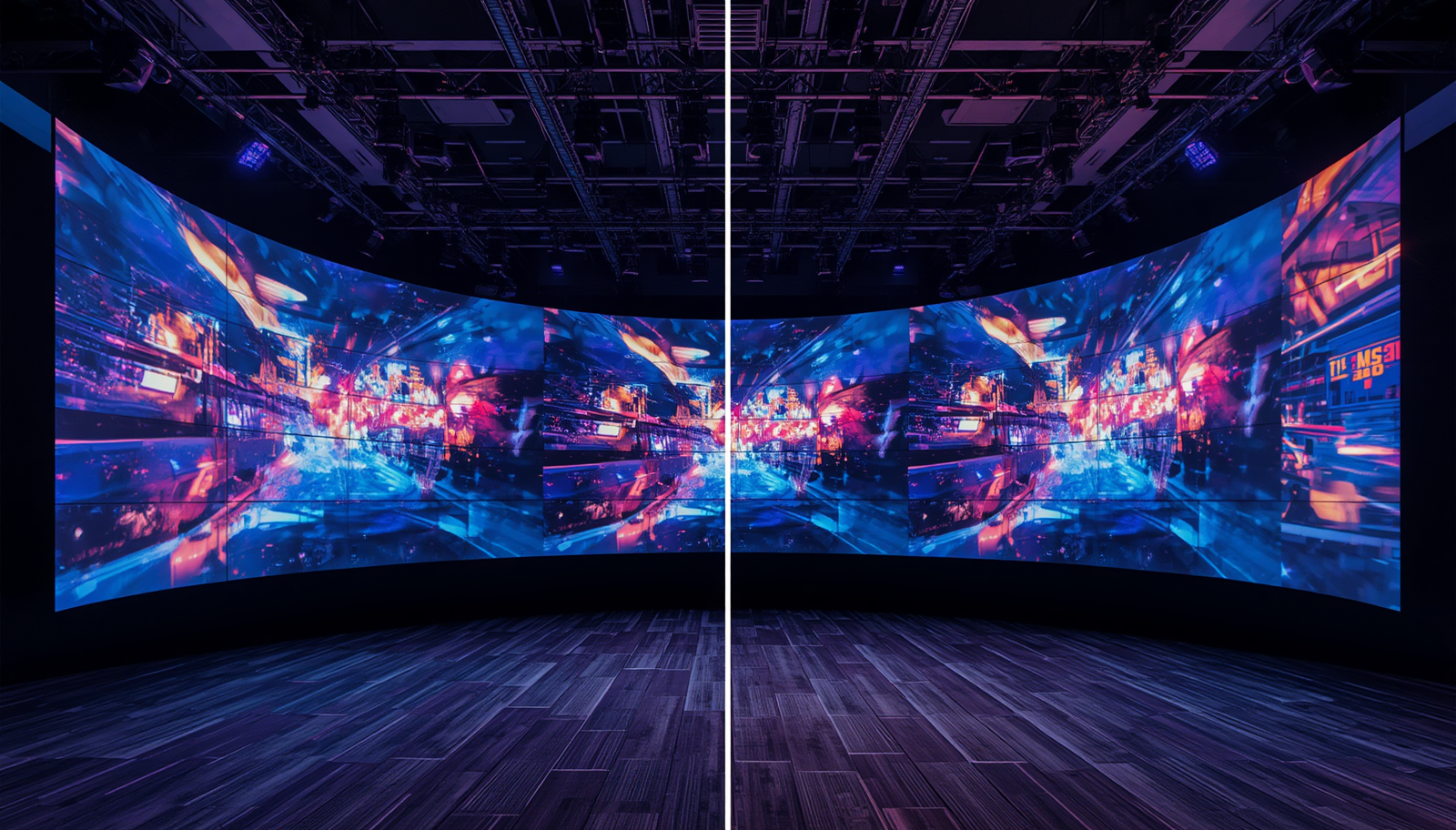
When the Colorado Convention Center unveiled its massive curved LED video wall in the main atrium, it wasn’t just an architectural statement—it signaled a fundamental shift in how large venues approach display technology. The installation, spanning over 80 feet with a gentle 15-degree curve, creates an immersive viewing experience for thousands of attendees simultaneously.
For hardware engineers and system integrators evaluating display technology for conventions, this project raises a critical question: should your next large-venue specification follow the curved LED path, or does LCD video wall technology still offer the better solution? The answer depends on understanding the nuanced technical trade-offs between curved LED vs LCD video wall systems, particularly in installation flexibility, visual performance, and total cost of ownership.
Key Technical Differences Between Curved LED and LCD Video Walls
The fundamental architecture of LED and LCD video walls creates distinct performance envelopes that engineers must evaluate against project requirements.
Pixel Pitch and Viewing Distance
Curved LED video walls typically use direct-view surface-mount diodes arranged on modular panels. Pixel pitch—the distance between LED centers—ranges from 0.9mm for ultra-fine pitch indoor applications to 10mm or more for large-scale outdoor installations. For convention center applications, a 1.5mm to 2.5mm pitch is common, delivering acceptable resolution at viewing distances of 3-8 meters.
LCD video walls, by contrast, achieve significantly higher pixel density. A 55-inch LCD panel at 4K resolution offers a pixel pitch of approximately 0.3mm, enabling crisp imagery at close viewing distances. This makes LCD the clear choice when attendees will be within 2-3 meters of the display.
Brightness and Ambient Light Performance
Curved LED walls excel in high-ambient-light environments. With typical brightness levels of 600-1,500 nits for indoor installations and up to 5,000 nits for outdoor-rated panels, LED walls remain readable even in direct sunlight. The Colorado Convention Center installation, positioned near floor-to-ceiling windows, required this brightness capability to maintain image visibility during daytime events.
LCD video walls typically deliver 500-700 nits for standard commercial panels, with some industrial-grade modules reaching 1,000-1,500 nits. In controlled lighting environments—such as darkened auditoriums or exhibition halls with strategic lighting design—LCD brightness is more than adequate and often preferable for its superior color consistency.
Color Accuracy and Uniformity
Engineers evaluating display technology for conventions should note that LCD panels generally offer better color uniformity across the entire display surface. Each LCD module is factory-calibrated for consistent white point and color gamut. LED walls, while improving rapidly, can exhibit slight color variations between individual modules that require ongoing calibration.
The Role of Curvature: Design Flexibility, Viewing Angles, and Installation Challenges
Curvature is the defining differentiator in this comparison, and it introduces both opportunities and engineering constraints.
Design Flexibility and Immersive Experiences
Curved LED walls offer unmatched design flexibility. Because each LED panel is a self-contained tile, they can be arranged in concave, convex, or even S-curve configurations limited only by the supporting structure. The Colorado Convention Center chose a concave curve to wrap the display around the atrium’s architectural columns, creating a natural focal point that draws visitors into the space.
LCD video walls achieve curvature through two methods: mechanical bezel bending (limited to approximately 5-10 degrees) or using specially manufactured curved LCD panels. Both approaches carry trade-offs. Mechanically bent LCD walls risk panel stress and reduced lifespan, while custom curved LCD panels require longer lead times and higher per-unit costs.
Viewing Angle Performance
For large venue displays, viewing angle consistency is critical when audiences span a wide field of view. Curved LED walls maintain near-perfect viewing angles up to 160 degrees horizontally and vertically, as each LED emits light in a wide cone. This eliminates the color shift and contrast degradation that plagues LCD panels when viewed off-axis.
High-end LCD panels with IPS or VA technology achieve 178-degree viewing angles in theory, but in practice, color shift becomes noticeable beyond 60 degrees off-center. For convention center installations where viewers may be positioned at extreme angles, curved LED holds a clear advantage.
Installation and Structural Considerations
The engineering challenges of curved LED vs LCD video wall installation differ significantly. LED walls require a custom mounting structure—typically aluminum extrusion or steel framework—designed to the exact curvature specification. This adds 15-30% to installation costs compared to flat installations and requires precise on-site measurement and fabrication.
LCD video wall installations are more straightforward for flat configurations but become complex when curvature is required. The mounting frame must accommodate the mechanical bezel bending or support individual panels at slightly different angles. Power and signal cabling also becomes more challenging, as each LCD panel requires its own power supply and video connection.
When LCD Video Walls Still Win: Tiled Bezels, Pixel Density, and Indoor Ambient Light Control
Despite the growing popularity of curved LED walls, LCD video wall technology remains the superior choice for specific applications.
Tiled Bezel Advantages
The most obvious drawback of LCD video walls—visible bezels between panels—can actually become an advantage in certain scenarios. For data visualization and control room applications, the bezels create a natural grid that helps operators mentally separate information zones. The Colorado Convention Center’s LED wall, by contrast, creates a seamless canvas that requires software-based zoning for multi-content display.
Modern LCD video walls achieve bezel widths of 0.9mm to 3.5mm, making the grid nearly invisible at typical viewing distances. For applications requiring both large-format display and fine-grained information presentation, LCD’s bezel grid can be a feature, not a flaw.
Superior Pixel Density for Close-Viewing Applications
When display technology for conventions requires detailed content visible from 1-3 meters, LCD video walls outperform LED. Consider a convention center’s wayfinding display or interactive kiosk: attendees standing directly in front of the screen need to read small text and recognize fine details. An LCD wall’s 4K resolution on a 55-inch panel delivers approximately 80 pixels per inch, while a 2.5mm pitch LED wall offers only 10 pixels per inch.
Cost-Effectiveness for Indoor Applications
For indoor installations where ambient light is controlled and viewing distances are moderate, LCD video walls offer significantly lower total cost of ownership. Industry estimates suggest LCD video walls cost 40-60% less than equivalent-sized fine-pitch LED walls for indoor applications. Maintenance costs are also lower, as individual LCD panels can be replaced without recalibrating the entire display.
How Relialink’s Industrial LCD Modules Complement Large-Format Display Projects
While curved LED walls dominate headline installations like the Colorado Convention Center, the majority of large-venue display projects still benefit from LCD technology—particularly when reliability, image quality, and cost are primary considerations.
Relialink’s industrial LCD modules are engineered for the demanding environments that convention centers, auditoriums, and exhibition halls present. Our modules feature:
- Extended operating temperature ranges (-20°C to +70°C) for installations near HVAC vents or exterior walls
- High-brightness options (up to 1,500 nits) with automatic ambient light sensing for consistent visibility
- IPS technology delivering 178-degree viewing angles with minimal color shift
- Industrial-grade components rated for 50,000+ hours of continuous operation
- Custom optical bonding for reduced glare and improved contrast in high-ambient-light conditions
For system integrators designing hybrid display solutions, Relialink’s LCD modules can complement LED walls in several ways. Use LCD video walls for secondary displays, wayfinding kiosks, and close-viewing content zones, while reserving curved LED for the primary immersive display. This hybrid approach optimizes cost and performance across the entire venue.
Our engineering team works directly with integrators to specify the correct LCD module for each application, ensuring mechanical compatibility, interface integration, and environmental compliance. Whether you need a standard 55-inch video wall panel or a custom-sized module for a unique architectural integration, Relialink provides the technical support and manufacturing flexibility that large-venue projects demand.
Making the Final Decision: Curved LED vs LCD for Your Venue
The choice between curved LED and LCD video walls ultimately depends on your specific project requirements. For convention centers and large venues where immersive experiences, wide viewing angles, and high ambient light tolerance are priorities, curved LED walls deliver unmatched impact—as demonstrated by the Colorado Convention Center installation. For applications requiring superior pixel density, controlled lighting environments, and lower total cost of ownership, LCD video walls remain the practical choice.
The most successful large-venue display strategies often combine both technologies. A curved LED wall creates the dramatic centerpiece, while LCD video walls handle wayfinding, sponsorship displays, and close-viewing content zones. This hybrid approach maximizes visual impact while maintaining budget discipline and operational reliability.
Looking for a reliable LCD module supplier for your next large-venue display project? Contact Relialink today to discuss your custom display requirements. Our engineering team can help you evaluate the curved LED vs LCD trade-offs specific to your installation and recommend the optimal LCD solution to complement your overall display strategy.
Related Reading
- InfoComm 2026: LED vs LCD Displays for Professional Digital Signage — the same LED-vs-LCD decision from a signage procurement and total-cost-of-ownership angle.